Key points
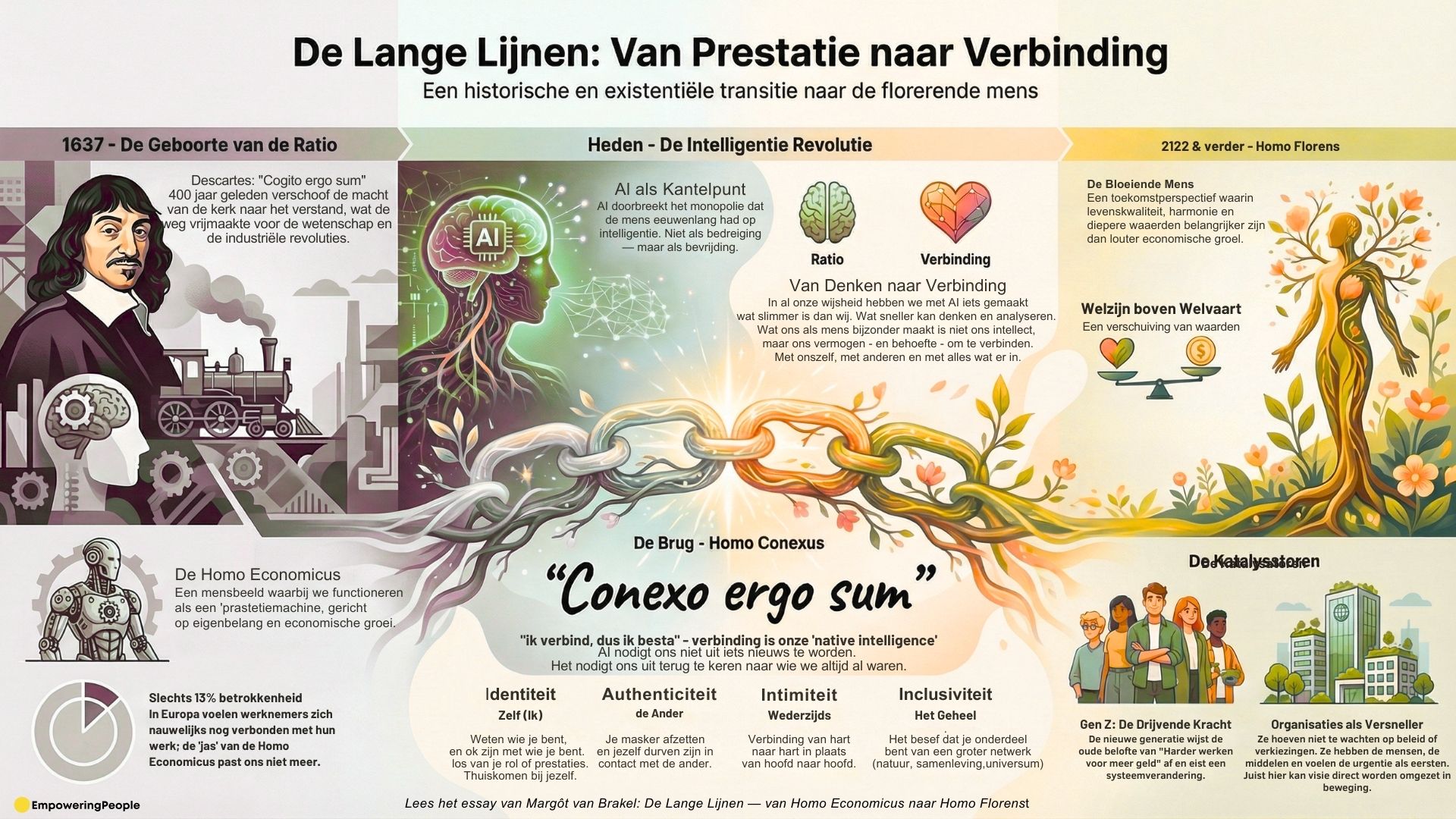
· AI is not simply the next wave of the industrial revolution. It is a revolution in its own right — the intelligence revolution.
· Our dominant model of humanity — the Homo Economicus — no longer fits.
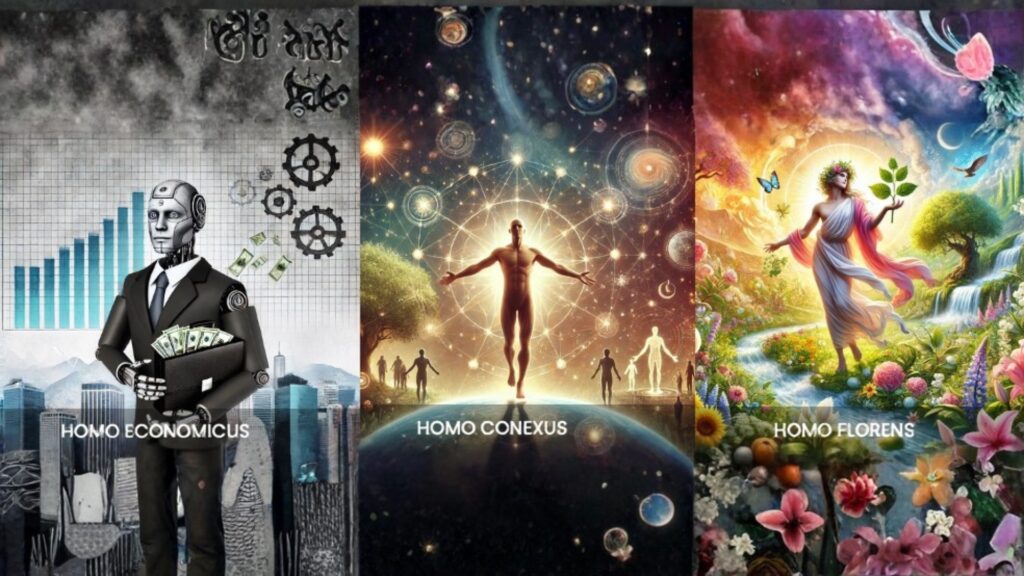
· The Homo Florens is the long-term vision. But the leap is too large without a bridge.
· That bridge is the Homo Conexus: connection as a way of being.
· Europe is well positioned to take a leading role in the systemic change ahead.
· Organisations have the power and momentum to accelerate this movement.
· Conexo ergo sum. I connect, therefore I am.
From Homo Economicus to Homo Florens — via Homo Conexus
AI, humanity and society. That is the territory we are navigating. What role does AI play in our lives, and what does it mean for people and for the world we share? What I notice, however, is that we keep asking a different question: “How do we implement AI?” This essay will not answer that. I am deliberately asking something else: “Who are we, now that AI is taking over our thinking?” It may sound philosophical — but it is urgent. Because without an answer, we are building a future we don’t understand on a foundation that is already shifting.
Buckminster Fuller said: specialists run the world, but generalists see the long view — and are therefore responsible for the movement. This essay is an invitation to take that long view. Not three years, not ten — but a hundred, perhaps four hundred years. Because that perspective might just be what helps us accelerate the movement.
Buckminster Fuller – ‘Bucky’ (1895 – 1983) on generalists & specialists
The American thinker, designer and maker Buckminster Fuller — known for his geodesic domes and his vision of the earth as ‘Spaceship Earth’ — identified an uncomfortable truth decades ago: the world is run by specialists. People who are deeply embedded in their field, who master the details and therefore hold the power. This didn’t happen by accident, he wrote. Specialisation makes people manageable. If you only see your own piece, you never ask the big questions.The generalist — the one who sees the whole picture, traces the long lines, and makes connections others miss — doesn’t have it easy. They face resistance. They’re seen as too vague, too broad, not concrete enough. But Fuller believed the generalist is indispensable. Not in spite of the big picture, but because of it. Fuller himself was exactly that: architect, philosopher, engineer, futurist and maker in one. He thought in systems, in timescales, in possibilities others couldn’t yet see.
400 years ago
When I look at history, I see a turning point around four hundred years ago. That is when René Descartes offered the world his insight: Cogito ergo sum — I think, therefore I am. It fit the spirit of the time. Power was shifting from the church to reason. Science and rational thought were given free rein.
That shift served us well. Human wellbeing improved dramatically over the centuries that followed. We lived through successive industrial revolutions — mechanisation, mass production, automation, connectivity.
And this development went hand in hand with economic growth. The natural habitat of the Homo Economicus: the human being who makes choices to maximise personal utility or profit.
Recognisable? This is our current way of being. A coat we wear, a model of humanity — perhaps a straitjacket. And while I don’t want to get ahead of myself: yes, this coat no longer fits. More on that shortly.
A new revolution
Looking ahead, we are shifting from industrial revolutions to something of an entirely different order. Until now, intellect was the exclusive domain of human beings. But AI has changed that. We have created something smarter than ourselves. This is not the next wave of the industrial revolution — it is a new revolution altogether: an intelligence revolution. And with that, we arrive at a fascinating and unsettling moment. A moment at which our own existence, our identity, our sense of what it means to be human may begin to waver. Or — to put it more generously — a moment at which it makes perfect sense to look at ourselves with new eyes. Does this coat still fit?
In recent years, various explorations of a future model of humanity have been commissioned, including by the Goldschmeding Foundation and ABP. Professor Patrick Nullens, Professor of Leadership Ethics at the University of Humanistic Studies, is clear on the matter: ‘The Homo Economicus can retire.‘ He introduced the concept of the Homo Florens — the flourishing human, living in harmony with the world around them. An almost Edenic image. Beautiful and full of hope. It sounds far away. And it is — if you see it as a single leap. But not if you see it as a path of growth. Because the journey towards it doesn’t begin somewhere in the future. It begins with you, today.
Where we are now
Looking at the present moment — back to the coat that no longer fits, the Homo Economicus, from which we are slowly turning away. I think we all feel it. Our values are shifting. We are beginning to understand that I cannot exist without the other. We are reaching the end of the age of the Economicus.
Gallup, the world’s leading research firm on employee engagement, measures this every year. Their most recent report is sobering: globally, only 21% of employees are truly engaged in their work. For Europe, the figure is even starker — just 13%. The lowest score in the world, five years running. In the Netherlands: 16%. In France and Germany: 8% and 12% respectively. People are functioning, but they are not flourishing. The Homo Economicus delivers output — but not connection.
What makes the data particularly interesting is the paradox it reveals. European employees also report less stress, less loneliness, and higher levels of wellbeing than their American counterparts — who score significantly higher on engagement. Americans appear to be more invested in their work, but also more stressed and more isolated. Europeans are less likely to tie their identity and sense of worth to their job — and they are happier for it.
It looks as though Europe has already, to some degree, begun to let go of the Homo Economicus logic — work as identity, performance as value — quietly, without fanfare. And that means Europe is not the laggard that the engagement figures might suggest. In fact, it is exceptionally well positioned to accelerate the systemic shift that is needed. Because those who have already loosened their grip on the Economicus don’t need to be convinced. They simply need direction — and the courage to step forward deliberately.
That said, letting go is not the same as arriving. Whoever releases the Economicus without a new compass will simply drift. And that is exactly what we see in many organisations today: people who no longer believe in the old story, but who don’t yet know the new one.
That direction begins with values. Not with economic models or policy frameworks — but with the fundamental question: what do we actually care about?
Which brings us to an illuminating piece of research by Glocalities. Their large-scale values research — conducted across broad populations — shows that people’s hopes and aspirations are shifting measurably toward wellbeing over wealth, and that safety, care, fairness and solidarity are the values people believe should guide society. At the same time, the Gen Z research by the same organisation shows that this shift is being accelerated from below. Research director Martijn Lampert puts it plainly: “the paradigm of the Homo Economicus is bankrupt.” The new generation is searching for a different model of what it means to be human.
So are we about to suddenly leap to the Homo Florens? If only it were that simple. These two models of humanity stand worlds apart — as different as fire and water. Two entirely different realities that could never touch each other, let alone be bridged by an act of will, however strong. The gap appears unbridgeable.
The bridge
Appears. Because there is a way. In 2019, I began exploring the question: what does it mean to be human in a world with increasingly capable AI? My conclusion was that what makes us uniquely human is not our intelligence. We have, after all, created something more intelligent than ourselves. What makes us human is something entirely different: our capacity — and our need — to connect. With ourselves, with each other, and with all that exists. I call this the Homo Conexus.
And it is precisely in the gap between the Homo Economicus and the Homo Florens that the Homo Conexus plays its role. It is the bridge. Through connection — with ourselves, with others, with the wider world — we loosen the grip of the Economicus. Connection leads us toward different values, from which we can begin to truly flourish.
Connection sounds simple. But in practice, it is anything but. We were raised in a system that taught us to perform, to optimise, to excel as individuals. Genuine connection was never cultivated as a quality in its own right.
And it is a quality. One that develops over a lifetime. Connection is not a state you arrive at and then maintain. It is a movement. You are in connection, and then you’re not. You reach toward yourself, toward another, toward the greater whole — and then you do it again. What grows is the ease with which you return — and the depth you find when you do.
Think about learning to ride a bike. You fell, you tried again, you concentrated on every tiny movement. Until one day, it simply happened. Cycling as second nature.
Connection works the same way. You begin unconsciously incompetent — you can’t yet see what you’re missing. Then you become aware of what connection actually demands, and it feels strange and unfamiliar. Slowly it becomes more conscious, more natural. Until it is simply how you are. Not a technique, but a way of being.
How connection works
Let’s go a little deeper into connection, because it is the essential quality at the heart of all this. How does it actually work? It is our compass. And it always moves from the inside out.
It starts with yourself. Who are you, beyond your role, your title, your achievements? Not who you think you should be — but who you are, right now. That is identity. Not as self-knowledge written in a journal, but as coming home to yourself. Knowing that you are completely okay, exactly as you are.
From that place of home, you can dare to be yourself in contact with others. Without a mask, without strategy. That is authenticity — and it is rarer than we think in a world that has trained us to adapt.
When you are yourself, and the other is themselves, something emerges. A dynamic you can feel. I see you, you see me. Je suis donc tu es. That is intimacy — not in the romantic sense, but in the human sense. A real encounter.
And then the greatest of all: the recognition that you are part of something far larger than yourself. Beyond people, beyond organisations. Connection with nature, with the universe, with all that is. That is inclusiveness — and it is the furthest point of the outward movement.
From inside to outside. From yourself, to the other, to everything that exists. Again and again. And through that connection, we find our way to values. To a future worth building. A future in which AI certainly plays a role — but a serving one, not a leading one.
And through the Homo Conexus — through that deepening quality of connection — we find our way to the Homo Florens. Not as a paradise to be reached, but as the human being we are becoming. Mastery in connection is the moment we arrive at the Homo Florens.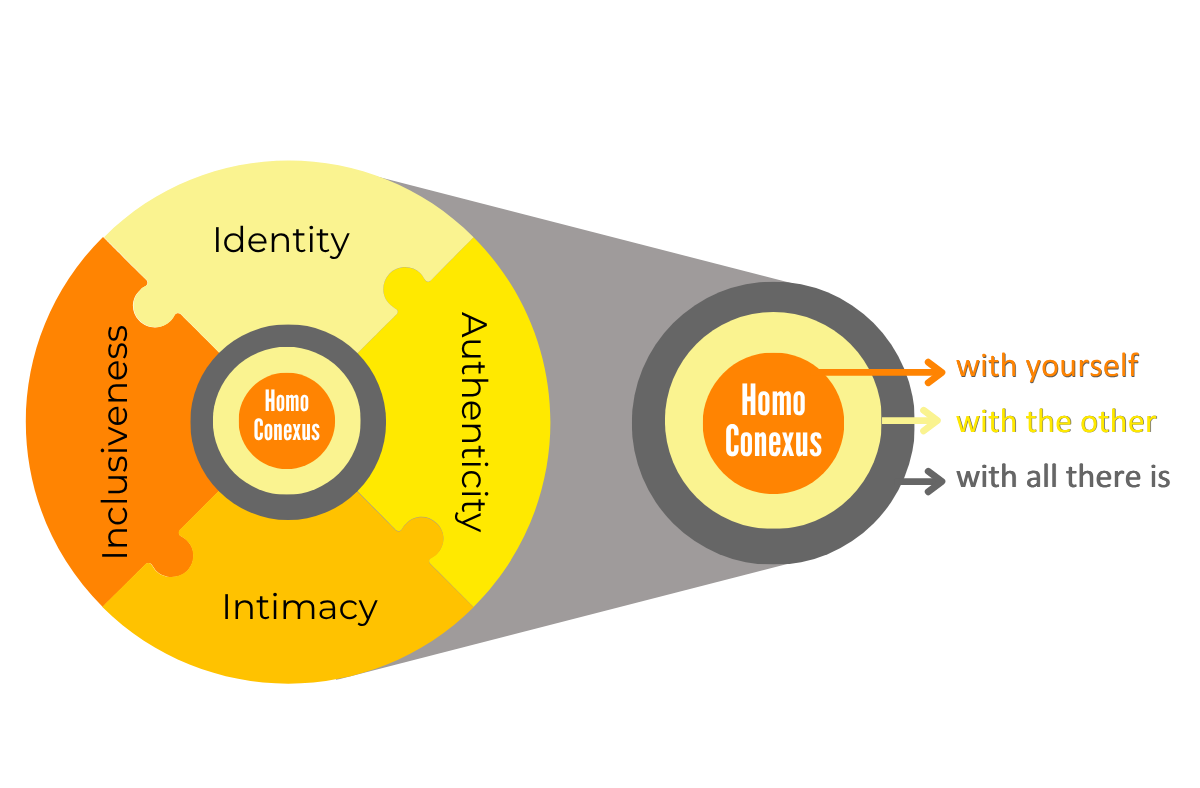
The younger generation as a driving force
One of the defining features of our time is the role of the younger generation — Gen Z. Not passive followers, but almost an insistent force. A brief sketch of who they are: roughly a third are idealists, socially oriented, engaged with issues of justice and climate. Another third are more pragmatic, focused on personal growth and security. What they share — and together they form a clear majority — is that the old promise of the Homo Economicus — work harder, earn more, climb higher — simply doesn’t speak to them anymore.
Now consider their influence. Why does this generation actually have leverage?
Partly because of scarcity: more people are leaving the labour market than entering it. This initially gave Gen Z bargaining power — the ability to make demands about work, culture and values. But that dynamic appears to be shifting. Large-scale reorganisations are putting more people back on the market. AI is being deployed to do more with fewer people.
And yet Gen Z’s influence remains significant, because they are the first generation to have grown up entirely within the internet, social media and digital technology. The digital world is their natural habitat. They bring with them instinctive skills and ways of thinking that organisations urgently need to navigate the current technological acceleration — skills that older generations simply don’t have.
This kind of generational pressure on the system is not new. The Baby Boomers did the same. They too were shaped by a unique set of circumstances — the first generation without war and poverty as a frame of reference — which made them, in a sense, inevitable. Institutions had to adapt, whether they wanted to or not. Now it is Gen Z’s digital DNA that carries that same quality of inevitability.
So we see a shift in values, with Gen Z as one of its key drivers — steadily eroding the foundations of the Homo Economicus.
The identity crisis of the native Homo Economicus
C-suite executives might well be seen as the archetypal Homo Economicus. Well-educated, hard-working, successful — they’ve built careers and earned their positions. With that comes significant responsibility for the continuity and growth of their organisations.
Last week I spoke with a CEO. After I’d walked him through the journey from Homo Economicus via Homo Conexus to Homo Florens, he looked at me and asked: “Do you know this — or do you hope it?”
In other words: am I an idealist or a realist?
A few years ago, when I wrote De Mens van Morgen back in 2019, I might have placed myself more in the idealist camp. But today, I see so much movement. So many initiatives, so many people in all kinds of positions who are finding the courage to take steps, to ask the question. And asking the question is a magnificent beginning. Do I know this, or do I hope it?
I dare to say: it is more than hope. It is trust. Not yet proof — but a deep and steady conviction that we are moving in this direction. That we will find the bridge, and cross into a future where harmony is not a dream but a given.
That conversation was not an isolated one. I speak with executives every week. The openness to seeing things differently is remarkable. That is new!
Who do I want to be?
I notice something remarkable. In my conversations with leaders, the questions are no longer only about their organisations. They are about themselves. Sometimes they are between jobs. Do I step back into the same race? Or is there something different I should be doing — for myself, for my people, for the world my children are growing up in?
That is connection surfacing, quietly and unannounced. And that is exactly what connection does: when you feel it, you also feel responsible. Not as an obligation, but as a natural truth.
And the shift from who do I want to be to who do I want to be as a leader is smaller than it seems. Because the identity we are being invited to reinvent operates at every level simultaneously — as individuals, as organisations, as society.
That is why leaders matter. Not politicians – they move from election to election, not in long lines. Not governments – they follow, they don’t lead. It is organisations that have the momentum. The room to move. The people. The resources. And therefore the responsibility to provide direction. To make choices that reach beyond the next quarter.
If a CEO dares to ask who do I want to be — the step to who do we want to be as an organisation has, in many ways, already been taken.
The chaos before the transformation
We are still early in this, and the path of transformation is not easy. Think of the familiar story of the caterpillar and the butterfly. The caterpillar enters the cocoon , and when the moment comes, the tender butterfly must struggle its way out. You cannot help it along. You cannot cut open the cocoon, because that would guarantee the butterfly doesn’t survive. The struggle is what shapes it. That is what makes the butterfly emerge exactly as it needs to; capable of flight.
The parallel to our own reality is this: we are in the ugly phase. The world is a mess. If you focus on everything that is going wrong, you can drown in it. It is a reliable path to despair. But if you shift your gaze – if you hold the perspective, see what is possible, and allow yourself to notice the positive developments alongside the chaos – then you will, as I have, find trust that we are moving toward something beautiful. And connection is the key word.
A system is a whole made of links. We are each a small link in a larger chain. We can change our own link – and when we do, the whole changes. Every link counts. Every link carries within it the greatness to contribute to the whole. That is what we are here to do.
Coming full circle
And the most beautiful part? This is not a fairy tale. It is a movement already underway — visible in the values that are shifting, in the generation demanding something different, in the leaders who dare to question what they once took for granted.
Fuller was right: specialists run the world. But generalists – people who can see the long view, who are willing to hold the big picture – are the ones who set the movement in motion. Not by knowing everything. But by taking the responsibility that comes with seeing the whole.
Four hundred years ago, Descartes said: I think, therefore I am. It marked the beginning of an era in which reason was everything. That era is drawing to a close. A new era is announcing itself, built on a different foundation:
Conexo ergo sum.
I connect, therefore I am.
That shift begins with you. Today.
Sources
- Prof. dr. Patrick Nullens – ‘De Homo Economicus mag met pensioen’ (2022), Universiteit voor Humanistiek Utrecht
- Glocalities – ABP 2022 – ‘Pensioenuitdagingen voor een bloeiende samenleving in 2122’ (2022)
- Gallup – State of the Global Workplace (2025)
- Glocalities – GenZ research – “Cultural Revolution Among Gen Z“
- Buckminster Fuller – Operating Manual for Spaceship Earth (1969)
- René Descartes – Discours de la méthode (1637)